
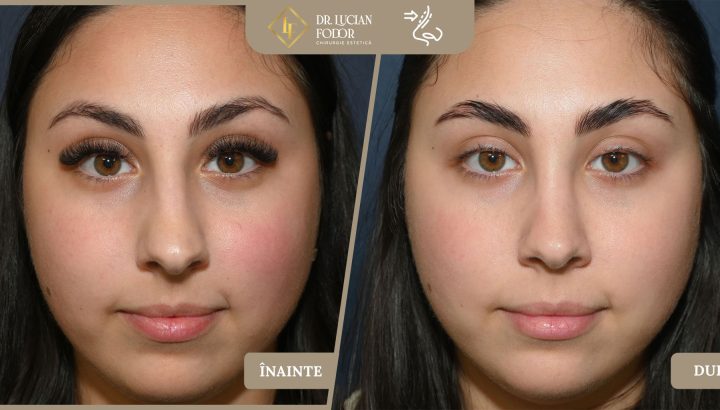
How the Patient Presented
The patient came in with a specific, well-defined concern: her nasal tip seemed too large and disproportionate relative to the rest of the nose and her facial features. The changes were not dramatic at first glance — the nose was not hooked, not deviated, the profile was relatively straight — but it was precisely this subtle discrepancy that was hardest to overlook: an overprojected, undefined tip that dominated the close-up view of the face and created an unsatisfying balance at the level of the lower third of the nose. On examination, the issue related to excessive volume of the tip cartilages, with a lack of definition and a rounded shape that undermined the natural elegance of the profile.
The Treatment Decision
Tip refinement cases are among the most delicate in rhinoplasty, precisely because the modifications are precise and small, yet their impact on overall appearance is significant. Excessive or poorly calibrated tip reduction would have resulted in a nose that looks operated on — with a tip that is too pinched or too artificial. The goal was to reduce volume without losing the naturalness of form — a smaller, more defined tip that remains in natural continuity with the rest of the nose.
The second component of the planning involved contouring the dorsal region, so that the tip reduction would be harmonized with an improved profile that would reflect the change in a balanced way.
Surgical Technique
The procedure focused on reshaping the nasal tip cartilages through selective reduction and repositioning, with emphasis on defining the contour and reducing excess volume without affecting nasal function. Concurrently, minor adjustments were made to the nasal dorsum to harmonize the profile with the new tip — achieving a coherent and proportional nasal line from root to tip.
Result
The nasal tip is now smaller, better defined, and proportionally integrated into the overall face. The nasal profile has gained elegance and clarity of line. The change, though calculated and controlled, has a significant visual impact on the general balance of the face — without indicating a surgical procedure and without eliminating the individuality of the features.


