
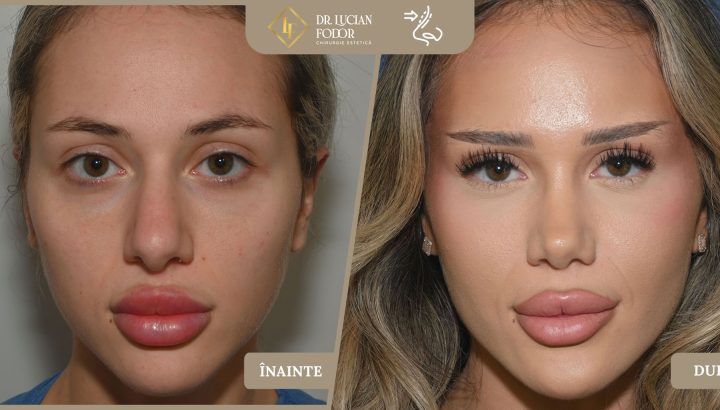
How the Patient Presented
The patient has a complex nasal concern in which several structural elements overlapped and amplified one another. The nasal pyramid was globally hypertrophied — the nose was large in both width and projection, with a visually dominant presence on the face. Added to this was a rightward deviation that created evident facial asymmetry when viewed from the front, and an oversized, drooping tip that accentuated the length of the nose and gave it a heavy, tired appearance. The nostrils were not balanced in proportion to the tip and nasal base. The clinical picture also included irregularities of the dorsal region, with an uneven surface that contributed to the overall impression of a nose disproportionate to the rest of the face.
The Treatment Decision
The complexity of this case required rigorous surgical planning with clear, prioritized objectives: reducing the overall volume of the nasal pyramid, correcting the rightward deviation, redefining the tip and nostrils, and recontouring the dorsal region for a smooth and natural profile.
The procedure was planned as a closed rhinoseptoplasty — an approach that allows full access to nasal structures through exclusively intranasal incisions, with no external scars. The closed technique is suitable for cases of medium to high complexity where the surgeon has the necessary experience to work rigorously without external exposure of the nasal skeleton.
Surgical Technique
The procedure simultaneously addressed all components of the problem through intranasal incisions (closed rhinoseptoplasty):
- Tip definition and reduction: the tip cartilages were reshaped, reduced in volume, and repositioned to correct both the oversizing and the previous drooping — achieving a smaller, more clearly defined tip, well-proportioned relative to the nasal base.
- Deviation correction: the nasal axis was straightened through interventions at the level of the nasal bone and septum, restoring symmetry as seen from the front.
- Dorsal region recontouring: the nasal dorsum was regularized to eliminate irregularities and create a clean profile line, harmonized with the new tip.
- Nostril rebalancing: the shape of the nostrils was adjusted to be proportional to the new tip and the overall nasal base.
Result
The nose now has a reduced and proportional volume, with a well-defined, correctly positioned tip and a clean, even dorsal profile. The deviation has been corrected, symmetry restored, and the nostrils are balanced. The change is profound — the nose no longer dominates the face — but the result does not resemble a standardized or artificial nose: every correction was adapted to the patient’s individual morphology.


