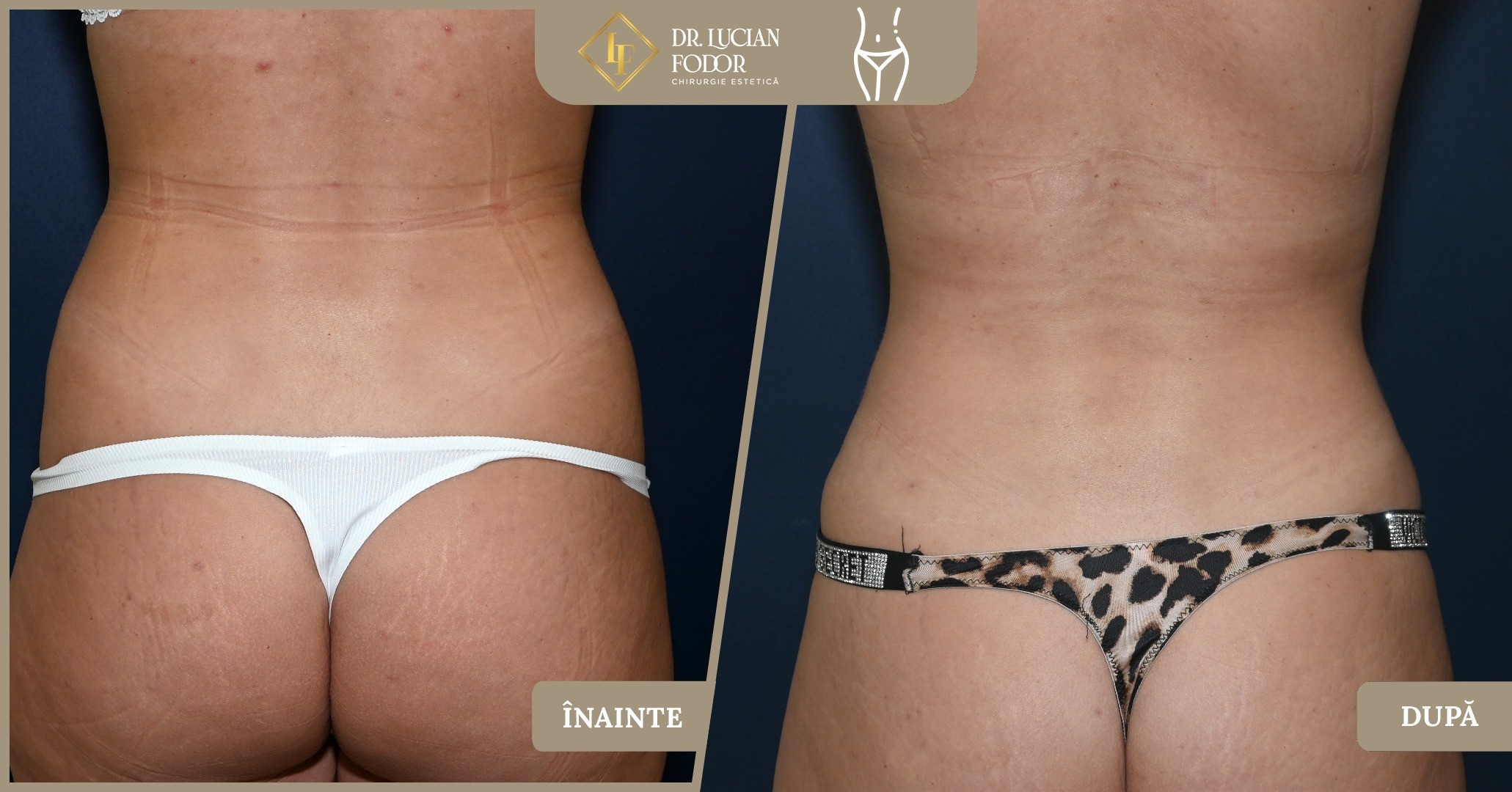
How the Patient Presented
The patient presented with a concern about contour, not weight. Localised fat deposits over the abdomen and flanks persisted independently of weight fluctuations and had not responded to diet or sustained physical activity — the classic picture of localised lipodystrophy.
Examination confirmed the distribution: an abdominal fat deposit, accumulating particularly in the lower abdomen, and deposits over the flanks that widened the contour along the lateral trunk and interrupted the transition line between waist and thigh. The skin showed striae in the lower abdomen and moderate laxity, but elasticity was sufficient to allow retraction once volume was removed — a decisive factor for the indication, because liposuction reduces volume but treats neither striae nor skin excess. The abdominal wall musculature was competent, with no diastasis, which excluded the need for an abdominoplasty.
The Treatment Decision
The indication for liposuction is established by exclusion, not by request. It is not fat volume in itself that justifies the procedure, but the combination of localised deposits, resistance to conservative measures, elastic skin and a competent abdominal wall. In the absence of skin elasticity, removing volume would leave skin that does not retract, and the result would be worse than the starting point. In this case, all the conditions were met.
The second decision concerned the extent of the areas treated. The abdomen and flanks were addressed in the same procedure, not for reasons of efficiency, but because treating the abdomen in isolation would have left the lateral deposits in place and accentuated the contrast between a slimmed waist and an unchanged lateral contour. Body contour is judged as a whole, from every angle — an area treated in isolation does not produce a harmonious contour, it produces an abrupt transition.
Surgical Technique
The procedure consisted of liposuction of the abdomen and flanks, with the aspiration zones and transition zones planned preoperatively, with the patient standing. The stages were:
- Preoperative marking of aspiration and transition zones: the fat deposits and their borders were marked in the upright position, together with the transition zones in which aspiration would be progressively reduced. These transition areas are what determine whether the result looks natural or shows visible steps.
- Infiltration of tumescent solution: the adipose tissue was infiltrated with tumescent solution, which facilitates aspiration, reduces intraoperative bleeding and contributes to postoperative comfort.
- Aspiration of the deep fat layer in the abdominal region: aspiration was carried out predominantly in the deep fat layer, preserving a uniform superficial layer. Maintaining this layer is the condition for smooth skin; excessive superficial aspiration produces irregularities that are difficult to correct later.
- Contour remodelling of the flanks: the lateral deposits were treated with particular attention to the transition line between waist, flank and thigh, so that volume reduction would restore a continuous curve rather than a localised depression.
- Intraoperative smoothing and symmetry check: at the end of aspiration, the contour was verified by comparative bilateral palpation and smoothed, in order to correct any difference in thickness between the two sides before completing the procedure.
Result
The posterior view shows the clearest change: the flank deposits no longer widen the silhouette, and the waist now has a defined concave line that was absent preoperatively. From the front and in profile, the abdominal contour is visibly reduced, with far less anterior projection in the lower abdomen.
The transition between waist, flank and thigh is continuous, with no steps or localised depressions — the criterion by which a liposuction is actually judged, and more important than the amount removed. The pre-existing striae remain unchanged, as expected: liposuction alters volume, not skin quality. A moderate degree of skin laxity also persists in the lower abdomen, visible in the postoperative images.
The result is not a reduction in weight but a change in shape: the same body, with its proportions redistributed.